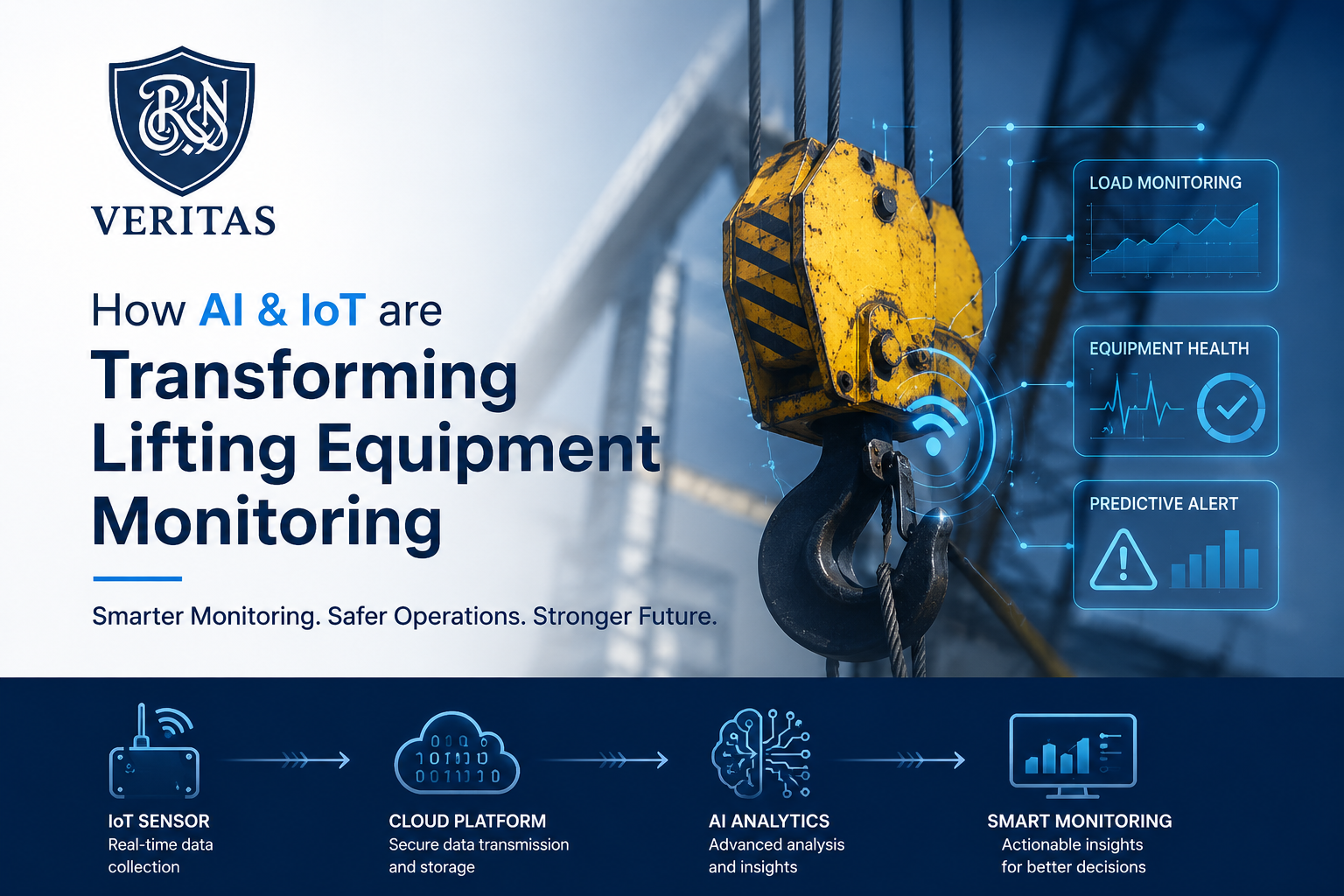
In today’s fast-changing industrial environment, safety, efficiency, and compliance are no longer a choice, but a necessity. The conventional processes of lifting equipment inspection and monitoring are revolutionized by modern technology such as Artificial Intelligence (AI) and Internet of Things (IoT). These technologies are changing the face of lifting equipment management in businesses.
If you are a business owner of heavy-duty equipment, you should know about the impact of AI & IoT in lifting equipment monitoring.
What is Lifting Equipment Monitoring?
Lifting Equipment Monitoring is defined as “the continuous monitoring of the condition, performance, and safety of lifting equipment, such as cranes, elevators, and hoists.” Traditionally, this is done by manual inspection, periodic testing, and maintenance schedules.
The problem with this traditional method is that:
It often misses issues in real-time
Relies heavily on human judgment
Increases downtime due to unexpected failures
And this is where AI and IoT-based smart monitoring comes in!
Understanding AI & IoT in Industrial Applications
- Internet of Things (IoT)
The IoT refers to the connection of physical devices to sensors, enabling the collection of data in real time. In lifting equipment, IoT can be used to collect data on:
Weight of the load
Level of vibration
Temperature
Usage patterns
Stress on the equipment
- Artificial Intelligence (AI)
AI refers to the use of algorithms to analyze the data collected from IoT devices. AI can be used to:
Predict failures in the equipment
Identify abnormal patterns
Make decisions on maintenance
Key Benefits of AI & IoT in Lifting Equipment Monitoring
- Real-Time Monitoring & Alerts
With IoT sensors attached to lifting equipment, the operator is able to monitor the equipment in real-time.
✔ Immediate alerts for overload conditions
✔ Notifications for abnormal vibration conditions
✔ Alerts for possible failure conditions
The chances of accidents are reduced, and action can be taken well in advance.
- Predictive Maintenance
The biggest advantage of using AI in lifting equipment is predictive maintenance.
Instead of waiting for the equipment to fail, AI predicts:
When a failure is likely to occur
What to replace
When to maintain
This reduces:
Unplanned downtime
Repair costs
Equipment breakdown risks
- Improved Workplace Safety
Safety is the primary concern in industries that use lifting equipment. AI & IoT systems assist in this area by:
Identifying unsafe operations
Monitoring load limits in real-time
Preventing overloading accidents
With AI & IoT systems, businesses can ensure that lifting equipment operates within safe limits, thereby reducing workplace injuries.
- Improved Compliance & Certification
Compliance with government regulations is vital for industries that use heavy lifting equipment.
AI & IoT systems can automatically:
Record inspection data
Maintain digital logs
Generate compliance reports
This ensures compliance with government regulations and safety standards.
- Increased Equipment Lifespan
The continuous monitoring of equipment ensures that it is used within safe limits.
✔ Reduced wear and tear
✔ Servicing
✔ Optimum usage
The lifespan of the lifting equipment is also increased, thus saving on long-term investment costs.
- Data-Driven Decision Making
The AI technology used in the analytics offers useful insights to businesses, including:
✔ Equipment performance trends
✔ Operator efficiency
✔ Optimum usage
Applications of AI & IoT in Lifting Equipment
AI & IoT technologies find widespread applications in different types of lifting equipment:
- Cranes
Load Monitoring
Boom Angle Detection
Wind Speed Alerts
- Forklifts
Operator Behavior Monitoring
Collision Detection Systems
Battery Health Monitoring
- Hoists and Elevators
Motor Performance Monitoring
Cable Health Monitoring
Load Balancing
- Industrial Lifting Systems
Automated Inspection Reports
Remote Monitoring Dashboards
Smart Maintenance Alerts
Challenges in Implementing AI & IoT
Apart from the benefits, there are some challenges that businesses might face in implementing AI & IoT. They are:
.Initial setup costs
.Need for skilled workforce
.Data security
.Integration costs
However, the benefits of this investment in the future would be greater than the costs, hence worth the investment.
Future Trends in Smart Lifting Equipment Monitoring
The future of lifting equipment monitoring is based on innovations. Some of the future trends in lifting equipment are:
Use of AI & IoT in digital twins for simulation and testing
5G technology for fast transmission of real-time data
Cloud-based lifting equipment monitoring
Autonomous lifting equipment operations
Why Your Business Needs Smart Monitoring Today
If your business currently employs conventional inspection approaches, then you are vulnerable to:
– Unexpected failures
– Safety hazards
– Regulatory non-compliance
– Increased maintenance expenses
By embracing AI & IoT technology for lifting equipment monitoring, you can:
✔ Enhance safety standards
✔ Minimize operational costs
✔ Meet regulatory requirements
✔ Increase productivity
Choose the Right Partner for Inspection & Certification
To make an impact with AI & IoT solutions, they must be paired with a strong inspection and certification service.
A good partner will help you with:
- Accurate inspection
- Correct certification
- Smart monitoring system implementation
- Support and maintenance
The implementation of AI & IoT in lifting equipment monitoring is no longer a trend, but a future requirement for businesses to stay ahead of the game and to avoid potential risks and penalties in their operations.
Don’t wait for equipment failure to take action.
Switch to smart monitoring and secure your operations for the future.